BrookyU · Opinion — Lane Conditions
This article explores the scores behind this year's Striking Against Breast Cancer (the Luci) Tournament from Squad to Squad.
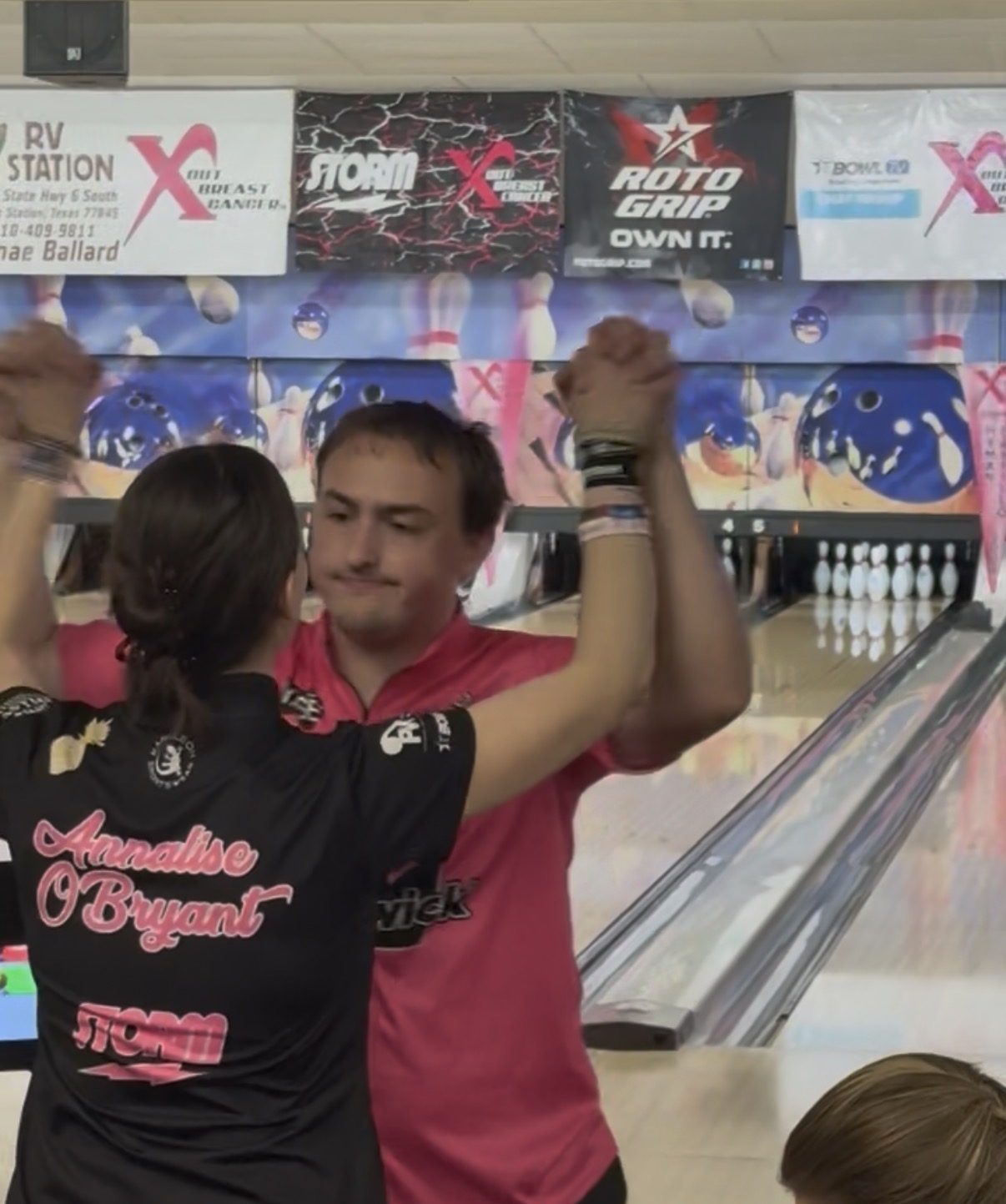
The 2026 Striking Against Breast Cancer Mixed Doubles tournament in Houston was another chapter in one of bowling's most meaningful and enduring events. Born in 2000 as a tribute to Luci Bonneau, a longtime PWBA player and close friend of tournament founder Donna Conners, “The Luci” has grown from a grassroots event that raised $7,000 in its first year into a marquee tournament that brings together some of the best male and female bowlers in the world while supporting the fight against breast cancer. This year, Spencer Robarge and Annalise O’Bryant added their names to that history, battling their way from 10th place to capture the 2026 title, with O’Bryant earning her first PWBA championship and Robarge his second PBA title. Congratulations to both of them on an outstanding performance. But this piece isn't really about who won — it's about what happened across the field before the champions were crowned. We bowled the event ourselves, pulled the squad-by-squad scoring data afterward, and started looking at the numbers out of curiosity. What emerged was something many tournament bowlers have suspected for years but rarely see quantified: the later squads didn't score like the early ones.
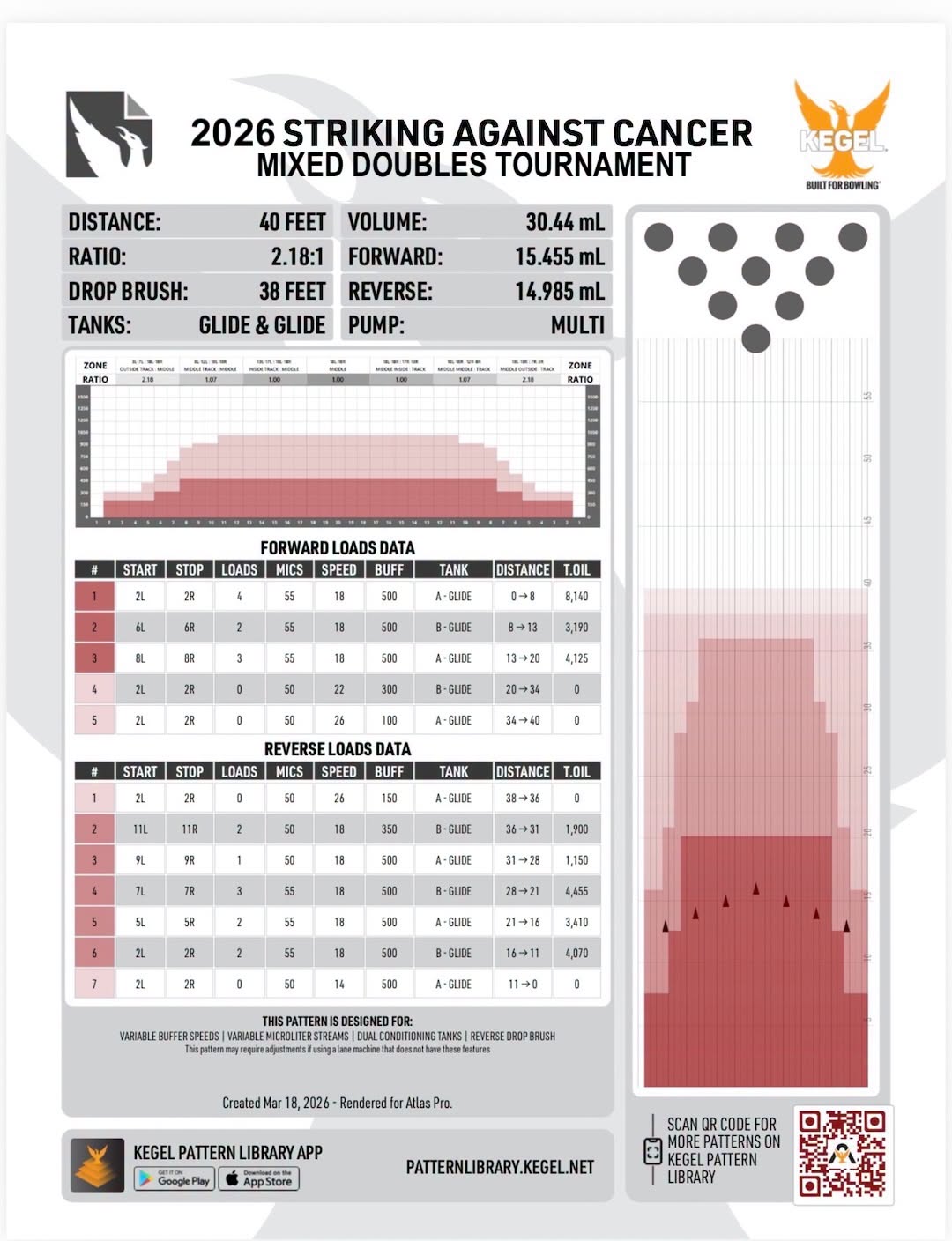
320 bowlers. One pattern — Striking Against Breast Cancer Mixed Doubles 2026 — laid down fresh for each squad. Four squads bowling the same event, same house, across two days — Squad A first, Squad D last. If a pattern truly plays identically every time it's put down, average scores across squads should be close to flat. They weren't.
Length
40 Feet
Ratio
2.18 : 1
Volume
30.44 mL
Field
Order
Averages by squad and gender, pulled from the full 160-team box score. "Bowlers Above Squad Average" is the count of bowlers in that squad who scored better than their own squad's average — worth reading as a skew indicator more than a difficulty score: a low count means a few big scores dragged the average up over most of the field; a high count means a few rough games dragged it down.
| Squad | Women's Avg | Men's Avg | Combined Avg | Bowlers Above Squad Avg |
|---|---|---|---|---|
| A (first) | 192.6 | 209.5 | 201.1 | 18/40 women · 20/40 men |
| B | 186.0 | 204.8 | 195.4 | 22/40 women · 20/40 men |
| C | 184.5 | 207.2 | 195.9 | 20/40 women · 25/40 men |
| D (last) | 185.7 | 200.6 | 193.2 | 23/40 women · 21/40 men |
Combined average (men + women, equal field sizes) by squad. The story isn't a clean staircase down — Squad C actually rebounded a bit over Squad B. But the two endpoints don't lie: first squad on the pattern, best score of the day. Last squad on the pattern, worst score of the day.
Combined Average by Squad
Squad A out-scored Squad D by 7.9 pins combined — 6.9 for the women's field, 8.9 for the men's. Both fields separately follow the same shape: a big drop after Squad A, then some movement in the middle squads, landing at their lowest point in Squad D.
Squad-to-squad comparisons only tell part of the story, since each squad is technically a different group of bowlers. So we also split every squad's own 7 games in half — Games 1–3 against Games 5–7 — to see whether scoring dropped off within the same bowlers' own set, on the same fresh lay they started on.
| Squad | Games 1–3 Avg | Games 5–7 Avg | Change |
|---|---|---|---|
| A (first) | 200.2 | 202.3 | +2.1 |
| B | 196.2 | 195.0 | −1.2 |
| C | 197.5 | 195.0 | −2.5 |
| D (last) | 193.7 | 192.3 | −1.4 |
The Standout Number
Squad A was the only squad that scored better in Games 5–7 than in Games 1–3. Every other squad's own numbers faded as their set went on — not just squad-to-squad, but within their own seven games, on lane conditions nobody else had touched yet. If this were purely bowler fatigue, we'd expect Squad A to fade too, on the same schedule as everyone else. It didn't. That points more toward the lane surface itself than the bowlers running out of gas.
Before trusting the squad drop-off above, we wanted to rule out the boring explanation: maybe one or two absurd sets — an Andrew Anderson stringing together a 1697, or a Tim Foy Jr. torching it for 1644 — are dragging a squad's average around. So we stripped outliers out and recalculated. First on the men only — using a flat cutoff of anyone whose 7-game total went over 1600 or under 1200 (that's ±200 pins against a 200-average scratch bowler's expected 1400) — since that's the check we ran first.
| Squad | Combined Avg (full field) | Combined Avg (men trimmed) | Change |
|---|---|---|---|
| A (first) | 201.1 | 199.4 | −1.7 |
| B | 195.4 | 194.1 | −1.3 |
| C | 195.9 | 195.6 | −0.3 |
| D (last) | 193.2 | 193.4 | +0.2 |
We didn't stop there, though — that 1200/1600 cutoff was built around a 200-average bowler, which fits the men's field (actual average: 205.5) reasonably well. It doesn't fit the women's field the same way. The women's field averaged 187.2 with a tighter spread than the men's, so the same flat cutoff lands unevenly on their distribution:
Applying the Men's Cutoff to Women
A Fair Cutoff, Built From the Women's Own Data
Recalculated With Both Sides Trimmed Fairly
Men trimmed by the flat 1200/1600 rule, women trimmed by the 1.5×IQR method: Squad A lands at 199.4, Squad B at 194.5, Squad C at 196.6, and Squad D at 193.4. The field-wide combined average moves from 196.4 to 196.0. The A-to-D gap holds at almost exactly the same 6.0 pins we saw trimming the men alone — because there simply aren't enough real outliers on the women's side to move the needle. The drop-off from first squad to last squad survives the outlier check.
This Is the Opinion Part
One tournament isn't a controlled study, and we're not claiming otherwise. But the pattern here (fresh squad scores highest, later squads score lower) matches what oiling techs and pattern nerds already talk about: a "fresh lay" isn't just about the pattern recipe — it's about the condition of the lane surface underneath it.
What Probably Contributes
What We're Not Claiming
The Pro-Am Factor
There's a wrinkle the squad-order framing above doesn't fully capture: Squad A and Squad D weren't just first and last through a clean four-squad rotation — they were first and last through a lot more lane traffic than that. Two practice squads and a pro-am squad went down Thursday, Squad A and Squad B bowled Friday, and then a packed Friday-night pro-am (spanning roughly 8–12 bowlers per pair, a real mix of styles) hit the same pattern before Squad C and Squad D came back to bowl Saturday. By the time Squad D bowled, that pattern had been laid down and bowled on at least seven separate times.
Stu Williams — who bowled in Squad A — raised this on the Beef and Barnzy podcast: a gap in the 8–9 pin range between Squad A and Squad D felt a little steep to him at first, but not surprising once you factor in how loaded Friday night's pro-am was. That's worth weighing heavily — it's a lane-traffic explanation from someone who was actually on the pattern, not just us reading a spreadsheet after the fact.
The Real Question Isn't "What Pattern Am I Bowling On?"
It's "Which Squad Am I Bowling In?"
Same pattern name. Same ratio, length, and volume on paper. But by the numbers, Squad A and Squad D at this event weren't the same lane condition — they were roughly an 8-pin swing apart. If you're drawing a late squad, go in expecting more transition, not less — and don't be surprised if the sheet doesn't play the way it did for the people who bowled it first.
None of the numbers in this piece would matter without the tournament itself, and that's what I want to pause and remember before we wrap up. Behind every score, every statistic, and every conversation about the conditions is an event that exists for something much bigger than bowling. The Luci once again raised meaningful money this year, while scholarship funds for young bowlers are being sent directly to USBC to be added to their SMART accounts. Giving young people the opportunity to continue their education through a sport we all love is about as meaningful a legacy as a bowling tournament can leave.
And none of that happens without the people who continue to believe in this event. To every sponsor who has supported The Luci over the years, thank you. Your contributions don't just keep a tournament on the calendar — they help keep its purpose alive.
Most of all, a heartfelt thank you to Donna Conners for creating this event, for honoring the memory of Luci Bonneau, and for carrying that vision forward for 26 years. And to the countless volunteers who give their time behind the scenes — including the team that spent hours verifying averages and making sure the competition could be scored fairly — thank you. Those are the people who make an event like this possible, even if their names never appear on the leaderboard.
This was our first year bowling The Luci. We came for the competition, we stayed for the experience, and we left with an even greater appreciation for what this tournament represents. We'll be back for #27.