BrookyU · Opinion — Lane Conditions
High-viscosity conditioner on an aging lane surface may not allow a "long pattern" to play long — a look at the brutal lane conditions of the inaugural PBA ELITE Regional.
The inaugural PBA ELITE Regional event at Steel City Bowl & Brews in Bethlehem, Pennsylvania, presented bowlers with the PBA ELITE Regional Long 48 pattern — roughly 30 mils of Kegel Terrain laid down across 48 feet. On paper, that's length: plenty of conditioner up front, plenty of room for the ball to retain energy before friction takes over. I expected to play close to the head pin and slowly migrate left with a fresh Forge Fuel, cleaning up to something weaker by game 7. That isn't what happened. I was at the gutter with a Nebula by game 3, fighting the lane the entire block, and I wasn't the only one. My hypothesis: the interaction between an 81 cP conditioner and an aging, high-friction Anvilane surface can effectively cancel out what a 48-foot pattern is supposed to give you. Here's the data behind that hypothesis — including numbers pulled straight off the pattern sheet that, I think, back it up.
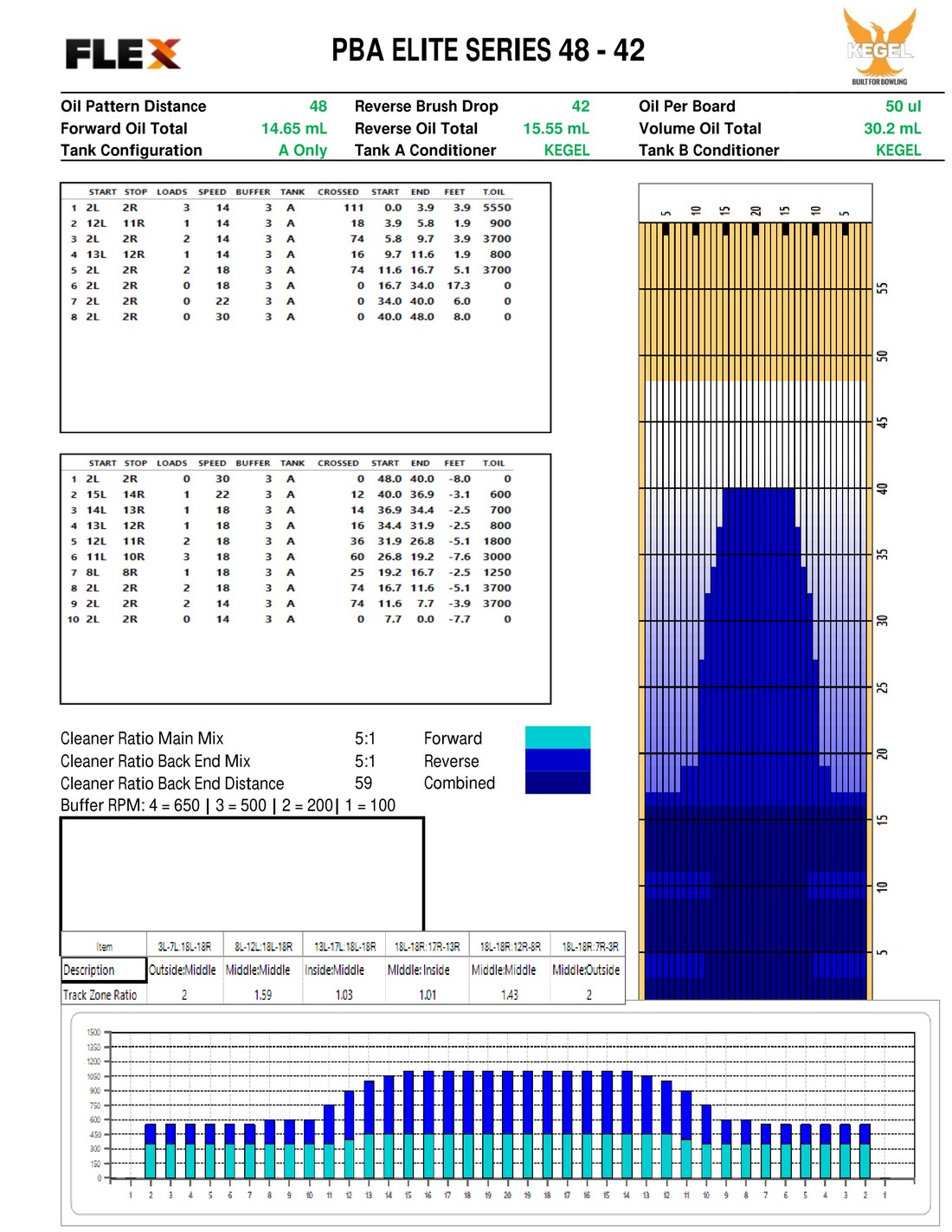
Officially, it's the PBA ELITE Series 48–42 — a 48-foot oil pattern with a 42-foot reverse brush drop, built entirely on a single tank of Kegel conditioner (no A/B blend). Here's what's on the sheet:
Pattern Distance
48 Feet
Total Volume
30.2 mL
Forward / Reverse
14.65 / 15.55 mL
The lanes played extremely difficult. I was essentially at the left gutter with a Nebula by game 3, fighting the lane. I didn't expect this to happen until game 6 at the very least. How was this even possible? I pondered this for a few hours after finishing at a disappointing -135 for my 7-game set. My working theory: the difficulty came from the interaction between the Kegel Terrain conditioner and the aging Brunswick Anvilane surface underneath it. Throughout the set, I wasn't chasing hook — I was just trying to find enough oil to get the ball to push through the front of the lane. That's not the adjustment most bowlers expect to make on a 48-foot pattern by game 3. And it wasn't an isolated experience — across both squads, bowlers including the national tour pros struggled to find traditional hold, push, and skid.
The $10,000 Question
Can a high-viscosity conditioner applied to an old, high-friction lane surface effectively negate the playing characteristics of a long oil pattern? Based on what was visible across both squads at the Elite Regional, I believe the answer may be yes.
Viscosity is a fluid's resistance to flow. A high-viscosity fluid has greater internal resistance to movement and flows more slowly than a low-viscosity fluid — in simple terms, honey is more viscous than water. Kegel Terrain has a published viscosity of 81.0 centipoise, placing it at the extreme high end of approved bowling lane conditioners. Terrain is also non-Newtonian and shear-thinning — its apparent viscosity changes under different forces, which Kegel designed to give high-rev players additional push while still letting lower-rev players hold traction.
What Viscosity Isn't
Why It Still Matters Here
We normally describe an oil pattern by its length, volume, and ratio. But there's another way to look at a lane: think of it front-to-back as a hill — not the left-right "hill" we talk about with oil distribution across the boards, but a friction hill.
Fresh, Low-Friction Surface
Old, Heavily-Used Synthetic
Imagine putting a golf ball on a fast, freshly cut green — the ball moves easily across the surface. Now imagine putting on an old, slow green with heavy grain: the grass resists the ball's movement, and the same stroke produces a dramatically different result. Now imagine putting against that grain. The ball doesn't just travel more slowly — the interaction between ball and grass changes the way it moves across the surface entirely. That's how I think about what happened at Steel City.
Old Anvilane
Kegel Terrain
A 48-foot pattern is supposed to create length: conditioner extends farther down the lane, giving the ball a longer window before it meets real friction. But pattern length describes where the brush stops — not how evenly the oil sitting under it is actually spread. After talking it through with Randy Weiss, he framed it a different way: it isn't just that the oil made the front of the lane difficult to get through — the pattern effectively gave the ball 48 feet of high-viscosity conditioner to interact with before it ever reached dry boards. In the friction-hill analogy, the ball was climbing against resistance for essentially the entire length of the pattern.
So we pulled the actual load zones off the FLEX printout to see where the pattern's 30.2 mL really lands. Every zone below carries oil; the buffer-only brush passes that stretch the pattern out to its full 48 feet — and add nothing but distance — are left off:
| Pass | Zone (ft from foul line) | Zone Length | Oil Deposited |
|---|---|---|---|
| Forward | 0.0 – 3.9 | 3.9 ft | 5,550 µL |
| Forward | 3.9 – 5.8 | 1.9 ft | 900 µL |
| Forward | 5.8 – 9.7 | 3.9 ft | 3,700 µL |
| Forward | 9.7 – 11.6 | 1.9 ft | 800 µL |
| Forward | 11.6 – 16.7 | 5.1 ft | 3,700 µL |
| Reverse | 36.9 – 40.0 | 3.1 ft | 600 µL |
| Reverse | 34.4 – 36.9 | 2.5 ft | 700 µL |
| Reverse | 31.9 – 34.4 | 2.5 ft | 800 µL |
| Reverse | 26.8 – 31.9 | 5.1 ft | 1,800 µL |
| Reverse | 19.2 – 26.8 | 7.6 ft | 3,000 µL |
| Reverse | 16.7 – 19.2 | 2.5 ft | 1,250 µL |
| Reverse | 11.6 – 16.7 | 5.1 ft | 3,700 µL |
| Reverse | 7.7 – 11.6 | 3.9 ft | 3,700 µL |
73% of the Pattern's Oil Lives in the First 16.7 Feet
Every microliter of the 14.65 mL forward pass lands between the foul line and 16.7 feet — 100% of it, with three separate buffer-only brush passes carrying the pattern out to 48 feet without depositing another drop. The reverse pass then stacks two more 3,700 µL loads back into that same 7.7–16.7 foot window. Add it up and 22,050 of the pattern's 30,200 total microliters — about 73% — sit inside the front 17 feet of a pattern whose headline number is 48. The rest of that length is real, and it matters for transition and backend read. But the bulk of the actual chemistry a ball has to fight through on the way down happens in barely a third of the lane — right where an 81 cP conditioner and an aging, high-friction Anvilane surface were, by hypothesis, compounding each other.
A lower-viscosity conditioner wouldn't automatically make the lane easier — lubricity, additives, volume, and application all matter. But a conditioner with lower viscosity and an appropriate lubricity package could potentially flatten the friction hill: instead of asking the ball to climb through a highly resistant front lane, it could let the ball move more freely through the heads and preserve more energy for the back of the lane.
| Golf Analogy | Lane Equivalent |
|---|---|
| Old, slow green | Aging Anvilane surface |
| Putting against the grain | Kegel Terrain (81 cP) on that surface |
| A green that lets the ball move with the grain | Lower-viscosity conditioner, appropriate lubricity package |
Perhaps the better way to evaluate a pattern isn't simply "how long is it?" but "how difficult is it for the ball to reach the end of the pattern with enough energy remaining to use it?" That question incorporates something the pattern sheet's headline number can't: the lane surface underneath it. A 48-foot pattern on a fresh surface is a completely different animal from the same 48-foot pattern on an aging, high-friction surface. Add an 81 cP conditioner with unusual rheological properties, and the interaction gets more complex still. That doesn't mean Terrain is a bad conditioner — at the same 30.2 mL, it may be great for short and medium patterns. Long patterns, on an aging surface, I'm not convinced it's the right choice.
Rather Than Oil → Breakpoint → Friction
Think Front-Lane Resistance → Energy Expenditure → Remaining Energy
An old, high-friction surface creates a steeper friction hill. A conditioner whose characteristics don't sufficiently mitigate that friction can make the hill steeper still. A lower-viscosity or otherwise better-matched conditioner may flatten it, letting the ball preserve energy and actually experience more of the pattern's intended length. A 48-foot pattern isn't necessarily a 48-foot experience — the pattern tells you where the oil ends; the surface and conditioner determine how difficult it is for the ball to get there.
We'll be playing this pattern again in Raleigh, NC, courtesy of Matt Taylor — who posted a 300 and finished 4th overall at Steel City — and I expect scores to run considerably higher there given a better lane surface and a different oil type on it. For everyone who made the cut at Steel City averaging around 200: well done. Special congratulations to Phillip Drumm for winning the Regular side. This week, the tour heads to Rocky Mount, VA for the first PBA ELITE Regional of the South.